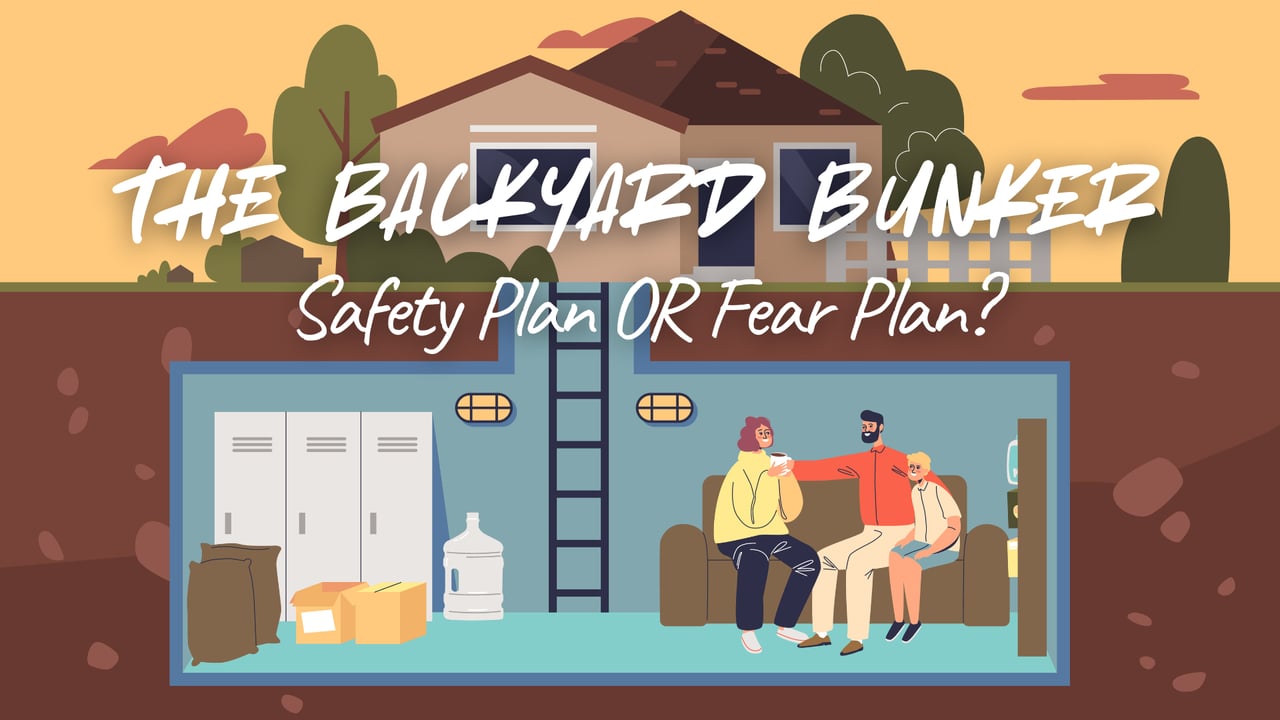
Lately, my social feeds have been filled with something I never expected to see trending in residential real estate: Backyard bunkers. Not storm shelters. Not safe rooms.
Full underground living spaces — bedrooms, food storage, generators, filtration systems, water reserves, even entertainment areas. Designed for long-term survival. And if we are being honest, these are not about tornado season.
These are about fear.
Where This Is Coming From
There is a noticeable undercurrent right now — talk of geopolitical instability, “World War III,” cyber threats, economic uncertainty, global tension. It is in headlines, podcasts, and dinner conversations.
When uncertainty rises, people look for control. A bunker feels like control. It says: “If everything collapses, I will be ready.” But here is the part few are saying out loud.
If we are truly talking about a catastrophic global event — nuclear escalation, planetary-scale disaster, something beyond regional impact — a residential backyard bunker is unlikely to be a permanent solution. At best, it may buy time. At worst, it is a very expensive illusion of security.
Remember “Bomb Shelters” of the 1950s
In the 1950s and early 1960s, during the height of Cold War tension between the United States and the Soviet Union, American families were building bomb shelters in their yards. It was the era of “duck and cover.” Nuclear drills in schools. Backyard fallout shelter advertisements in magazines.
Families stocked canned goods and water. Some shelters were concrete-lined, stocked, and sealed, waiting for an event that thankfully never came. History moved forward. The shelters did not.
Today, many of those structures sit abandoned, filled in, or repurposed as storage. They are rarely a selling feature when a home hits the market. Fear felt permanent in that moment. It was't.
Storm Shelter vs. Survival Compound
There is a very important distinction:
- A properly engineered storm shelter in a tornado-prone region? Practical.
- A safe room for personal security? Understandable.
- A fully outfitted underground survival suite built for months of isolation from a global collapse? That is a different psychological category.
The first two solve specific, localized risks. The third attempts to solve existential uncertainty. Those are not the same thing.
The Financial Reality
From a real estate standpoint, here is what concerns me:
- These projects are expensive.
- They are highly specialized.
- They appeal to a very narrow buyer pool.
In most markets, a bunker does not automatically increase resale value. In fact, it can complicate it.
Buyers may ask:
- Is it permitted?
- Is it dry?
- Is it engineered?
- Does it create drainage issues?
- Does it sit in an easement?
- What was the homeowner worried about?
Even more importantly: many buyers simply do not want to inherit someone else’s fear investment. A swimming pool is lifestyle. A kitchen remodel is utility. A bunker is psychology and psychology does not always appraise well.
Are Builders Feeding the Hype?
When there is fear in the air, there is also opportunity. Entire industries grow around uncertainty — security systems, prepper supplies, survival food kits, air filtration systems, and yes, luxury bunkers.
The marketing language is powerful: “Be prepared.” “Protect your family.” “Do not wait until it is too late.” That messaging works because it taps into something primal.
But before writing a large check, homeowners should ask: What specific risk am I solving for? Is this statistically likely in my location? Is there a less extreme way to create resilience? Am I buying protection… or reassurance?
Those are different things.
The Hard Truth
If there were truly a civilization-level catastrophic event, most private residential bunkers would not create indefinite survival. They might extend comfort for a period of time.
But they are not self-sustaining ecosystems. And that is the uncomfortable reality.
The bigger question becomes: Is the goal long-term survival… or short-term peace of mind?
A More Practical Approach
If what you want is resilience, there are far more balanced investments:
- Emergency preparedness kits
- Short-term food and water reserves
- Backup power systems
- Home hardening for regional risks (fire, wind, flood)
- Financial reserves
- Community relationships
Community, by the way, is historically the strongest survival asset humans have ever had. Not isolation.
Final Thought
I understand the instinct to protect what we love. Truly. But I also believe homes should be built around living well — not bracing constantly for the end of everything.
Preparedness is wise. But before you dig, ask yourself whether you are solving a real problem… or responding to a loud moment in history.
And from a real estate perspective, remember this: When fear cools — and it always does — your property will still need to compete in a normal market.
Preparedness is wise. But history reminds us that panic-driven construction rarely becomes tomorrow’s prized feature.
"A home should be a place of stability and life — not a monument to the loudest headline of the year.”